
Where legacy methods fall short of answering clinical question
Clinical decisions in oncology are cellular questions: which clones persist after therapy, whether a residual signal is malignant or benign, and whether a rare population is poised to drive relapse. Legacy standard of care methods answer these questions one assay at a time, and not sufficiently within the same cell. Sequencing-based genotyping, including bulk NGS and ddPCR, reports a variant allele frequency averaged across a sample, so it cannot say whether two mutations sit in the same clone or in separate ones. That ambiguity matters clinically when co-occurring mutations carry different prognoses or qualify a patient for different therapy. Protein-based phenotyping such as flow cytometry reads surface markers across a population, but stays blind to the mutations beneath them and shifts under treatment pressure, which complicates response assessment.
To connect those readouts, clonal relationships are reconstructed by inferring them, stitching separate genotyping and phenotyping datasets into a model of which cells carry which alterations. Those inferred datasets fail to break down precisely where clinical risk concentrates: in rare subclones, in mixed residual disease, and in the pre-malignant background that confounds molecular signals. Hematologic malignancies make this concrete, where distinguishing residual leukemia from clonal hematopoiesis changes the decision, but the same limits apply wherever clonal composition drives outcome. For clinical applications, inference of datasets and averages of data are no longer sufficient.
Single-cell multiomics resolves this directly. By measuring DNA mutations, targeted RNA transcripts, and cell-surface proteins within the same individual cell, it reconstructs true clonal architecture rather than inferring it, separates malignant clones from benign background populations, and surfaces rare clones that population averages hide. The result is sharper response characterization, earlier signals of resistance, and higher-resolution clinical endpoints, built on observed biology instead of inferred datasets.
Explore clinical applications by disease
Each application page details how single-cell resolution changes the clinical question for a specific malignancy. More disease areas are in development.
Single-Cell MRD in AML
Measurable residual disease (MRD), the leukemic cells that persist below morphologic detection, sets relapse risk. Population averages and inferred datasets leave legacy standard of care methods unable to resolve it. See how single-cell genotype plus immunophenotype measures MRD directly.
Additional applications
More disease-specific applications of single-cell multiomics are in development across oncology and beyond.
Clinical utility of single-cell anlysis
As disease progresses and treatment is applied, its clonal makeup keeps shifting. Single-cell analysis drives critical clinical decisions when applied across the entire disease course, from pre-malignant precursors through relapse. Hematologic malignancies illustrate the sequence below.

Precursor Mutations
Detect high-risk precursors
Identify the early clonal lesions that mark elevated risk, before disease is morphologically apparent.

Baseline Diagnosis
Reveal novel stratification opportunities
Resolve mutation co-occurrence and immunophenotype at diagnosis to tailor therapeutic strategy based on a patient's biology.

Interim Surveillance
Monitor response and rare subclones
Track which clones contract, persist, or expand under therapy, and catch rare subclones that are hidden to legacy methods.

Complete Remission
Characterize residual disease after treatment
In remission, distinguish true measurable residual disease (MRD) from benign clonal hematopoiesis, and resolve post-transplant chimerism (the mix of donor and patient cells).

Relapse
Identify distinct relapse disease attributes
Map the genotype and phenotype of relapsed disease, often distinct from diagnosis, to guide the next decision.

Disease Modeling & Research
Model disease biology and resolve mechanisms
Beyond patient timepoints, reconstruct clonal evolution, interrogate resistance mechanisms, and define single-cell biomarkers that inform translational research and clinical trial design.
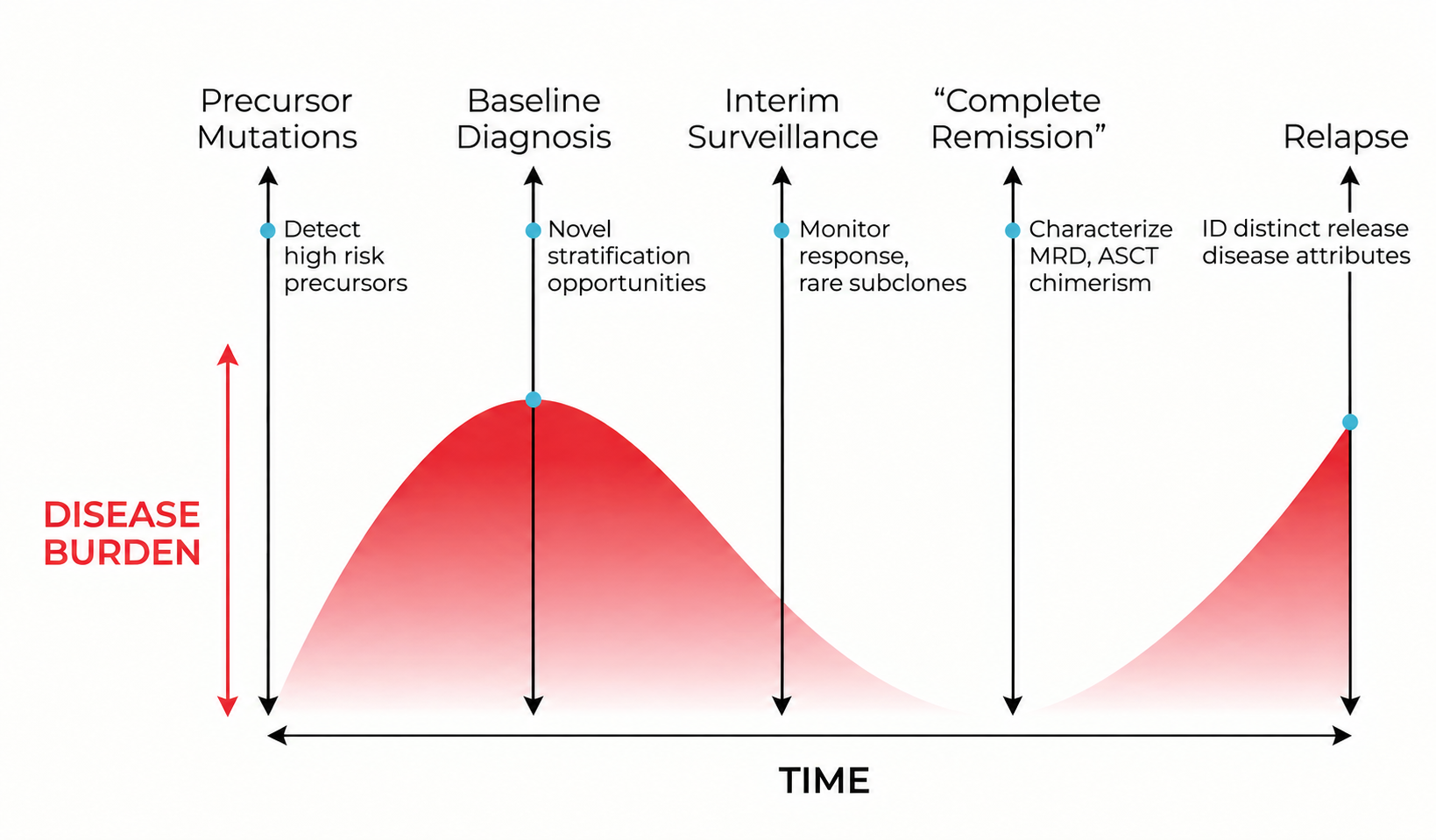
Single-cell intervention points across the hematologic disease course. Disease burden rises and falls with treatment, but the clonal makeup beneath it keeps shifting. Single-cell resolution applies at every decision point on the curve.
Improving on standard of care and trial safety monitoring
Two questions define clinical value: does the readout resolve what standard of care leaves ambiguous, and does it give trials a sharper, earlier, more confident signal. Single-cell multiomics addresses both.
1
Resolution beyond standard of care
Reading genotype and immunophenotype in the same cell resolves the false positives, false negatives, and discordant calls that arise when bulk sequencing and flow cytometry are interpreted separately, distinguishing malignant clones from benign clonal hematopoiesis and surfacing low-burden subclones.
2
Stronger trial safety monitoring
Clonal-resolution readouts give trials an earlier, more specific view of how treatment reshapes a patient's clones, supporting safety monitoring and the detection of resistant populations while intervention is still possible.
3
Higher-resolution endpoints
Single-cell MRD readouts sharpen trial endpoints with precise response definitions, enabling more confident evaluation of overall and relapse-free survival than population averages allow.
One platform for single-cell multiomic resolution
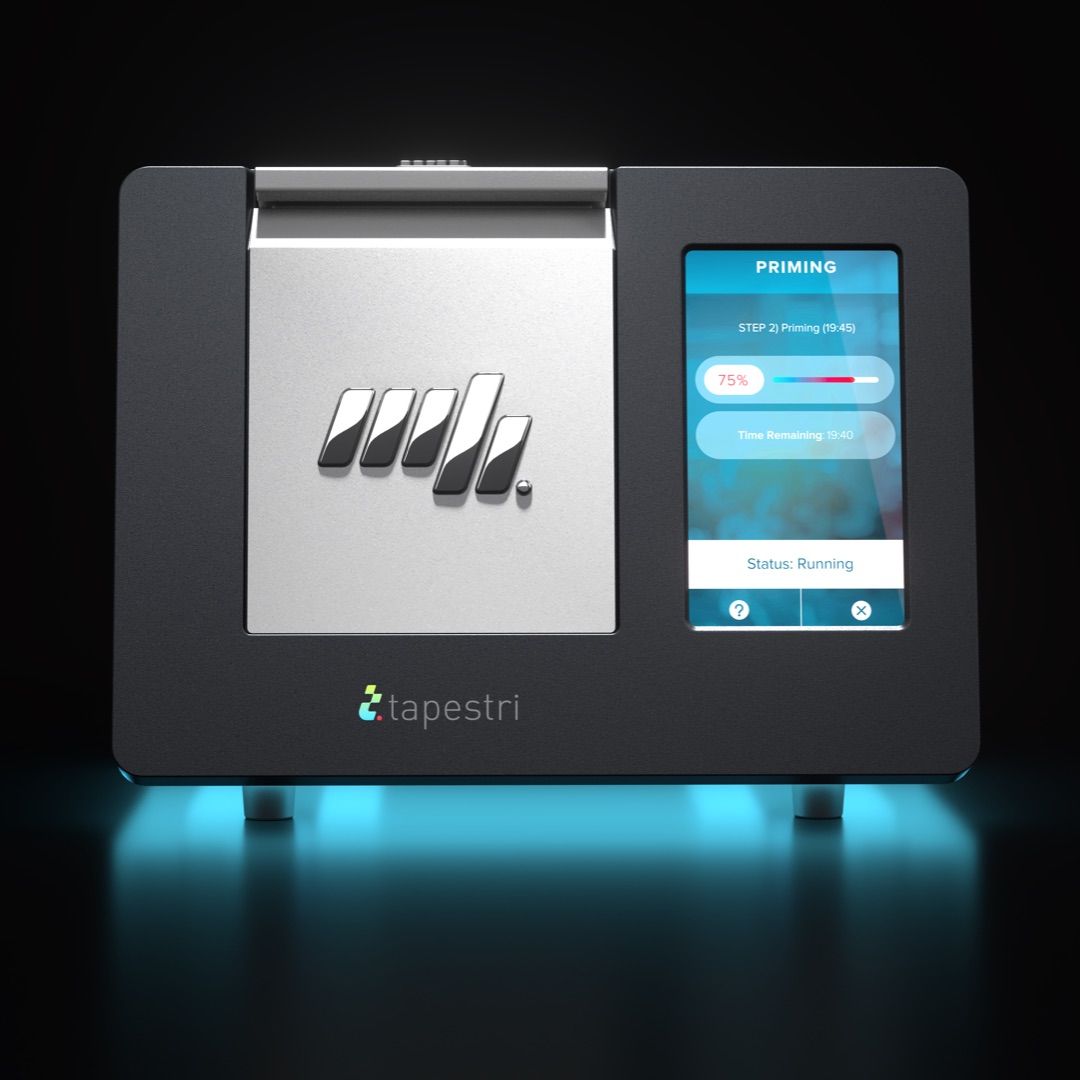
The Tapestri Platform co-measures DNA mutations, targeted RNA transcripts, and cell-surface protein expression within individual cells, providing the single-cell multiomic resolution behind every application above. It is the analytical foundation for tracking clonal evolution, separating residual leukemia from pre-leukemic clones, and defining precise clinical-trial endpoints. The same workflow runs in your own laboratory, transfers to CRO and CDMO partners, or is delivered through Mission Bio's Assay Services.
Bring single-cell resolution to your program
Start with a predesigned panel, or partner with us to build a purpose-built assay around your therapy development program.
Predesigned panels
Start with a validated panel
Choose from a catalog of predesigned single-cell panels built for oncology applications, ready to run on the Tapestri Platform.
Assay Services
Build a purpose-built assay
Work with our team to develop a custom single-cell assay fit to the needs of your therapy development program, from design through execution.