
Key Benefits
Overcoming Limitations in Gene Editing Safety and Genotoxicity Profiling
Moving a program forward toward the clinic or publishing in a high-impact publication means every data point can be a liability if not characterized effectively. While a cell & gene therapy or disease model may appear safe and effective on average, population-level data from legacy workflows can mask hidden, decision-changing threats. A single rare cell harboring an unintended off-target event or an aberrant vector integration can have catastrophic consequences. For therapeutic developers, these missed events can lead to safety failures and costly clinical holds under escalating regulatory scrutiny. For translational researchers, relying on inferred biology from split samples fails to satisfy the stringent demands of grant and manuscript reviewers.
To truly de-risk your program, you must move past these legacy workflows and build a rigorous, complete product profile before a patient is impacted or you have a setback in your funding. This is where Assay Services comes in. Each of the following critical attributes can be measured simultaneously within the exact same cell on the Tapestri® platform, replacing a stack of single-attribute assays with one purpose-built Assay Service.
By partnering with our expert team to design the assay, run it, and analyze the data, you get the definitive single-cell answers your program needs without the cost or complexity of standing up an in-house lab, purchasing instruments, or hiring new bioinformatics staff.

Zygosity and Co-Occurrence
Pain Point: A bulk editing efficiency number cannot show whether an edit lands on one allele or both, or whether multiple intended edits occur together in the same cell.
Solution: Single-cell resolution determines zygosity directly and confirms which edits co-occur within the same cell, data required to understand dose, potency, and functional outcome when the edited cell is the therapeutic product.

Multiplex Edits
Pain point: Simultaneous CRISPR edits need confirmation that all intended edits landed in the same cell, not just that each edit occurred somewhere in the population.
Solution: Multiplexed edit tracking verifies the complete intended editing profile within individual cells, confirming the presence of the full combination of gene edits or modifications in each cell within the sample or therapeutic product.

Vector Copy Number (VCN)
Pain point: Population-level VCN reporting is diluted by untransduced cells and the inability to detect the rare cell carrying five or more integrated copies, a threshold associated with elevated risk of insertional mutagenesis and toxicity.
Solution: Single-cell VCN profiling resolves the true distribution of vector integration across thousands of individual cells, identifying high-copy number outliers and supporting VCN reporting relative to the percentage of transgene-positive cells.

Transduction Efficiency
Pain point: Bulk transduction efficiency reports the fraction of cells that took up a vector, but not which specific cells, or how integration varies across different cell subsets within the same therapy product or sample.
Solution: Transduction efficiency is measured alongside vector copy number and immunophenotype in the same cell, revealing lineage-specific integration patterns, for example between CD4-positive and CD8-positive T cells, that bulk assays cannot distinguish.

Gene Expression
Pain point: Determining the downstream functional consequence of an edit, or using transcriptional signatures to identify specific cell types during in vivo biodistribution studies, requires multi-modal resolution. Running orthogonal DNA and RNA assays on split samples severs this connection, making it impossible to confirm if the modified cell is the exact cell expressing the target transcript.
Solution: Targeted single-cell gene expression is measured simultaneously with genetic modifications on the Tapestri® platform. By linking a gene editing or integration event directly to its transcriptional output, researchers can identify cell types across complex tissues, map downstream pathway expression, and precisely measure therapeutic efficacy.

Immunophenotyping
Pain point: Whether characterizing a cell therapy product or studying complex disease models, flow cytometry is the standard for assigning cells to immunophenotypic populations based on surface markers. However, this single-attribute approach cannot link a cell's phenotypic identity to its underlying genotype or transgene expression.
Solution: Surface protein markers are measured simultaneously with targeted DNA and RNA readouts in the exact same cell in single-cell multiomics. This connects the immune phenotype directly to the editing outcome or vector integration, helping therapeutic developers and academic researchers characterize cells and confidently link function to genetic modification.

Epigenetics
Pain point: Gene editing and viral vector integration can induce unintended epigenetic shifts, such as aberrant chromatin remodeling and altered DNA methylation patterns. Standard genotyping and transcriptional assays fail to capture these regulatory changes, obscuring the underlying mechanisms of transgene silencing or epigenetic toxicity in edited cell populations or cell therapy products.
Solution: Integrating epigenetic readouts into a single-cell multiomic workflow measures chromatin accessibility alongside targeted DNA and expression profiles. This multi-attribute resolution directly links a specific genetic intervention to its regulatory consequences, letting researchers map epigenetic toxicity and therapeutic durability at the per-cell level.
What can single-cell do for you?
The attributes below can be measured individually or in combination, regardless of whether the delivery method is viral, plasmid-based, or a CRISPR editing complex.
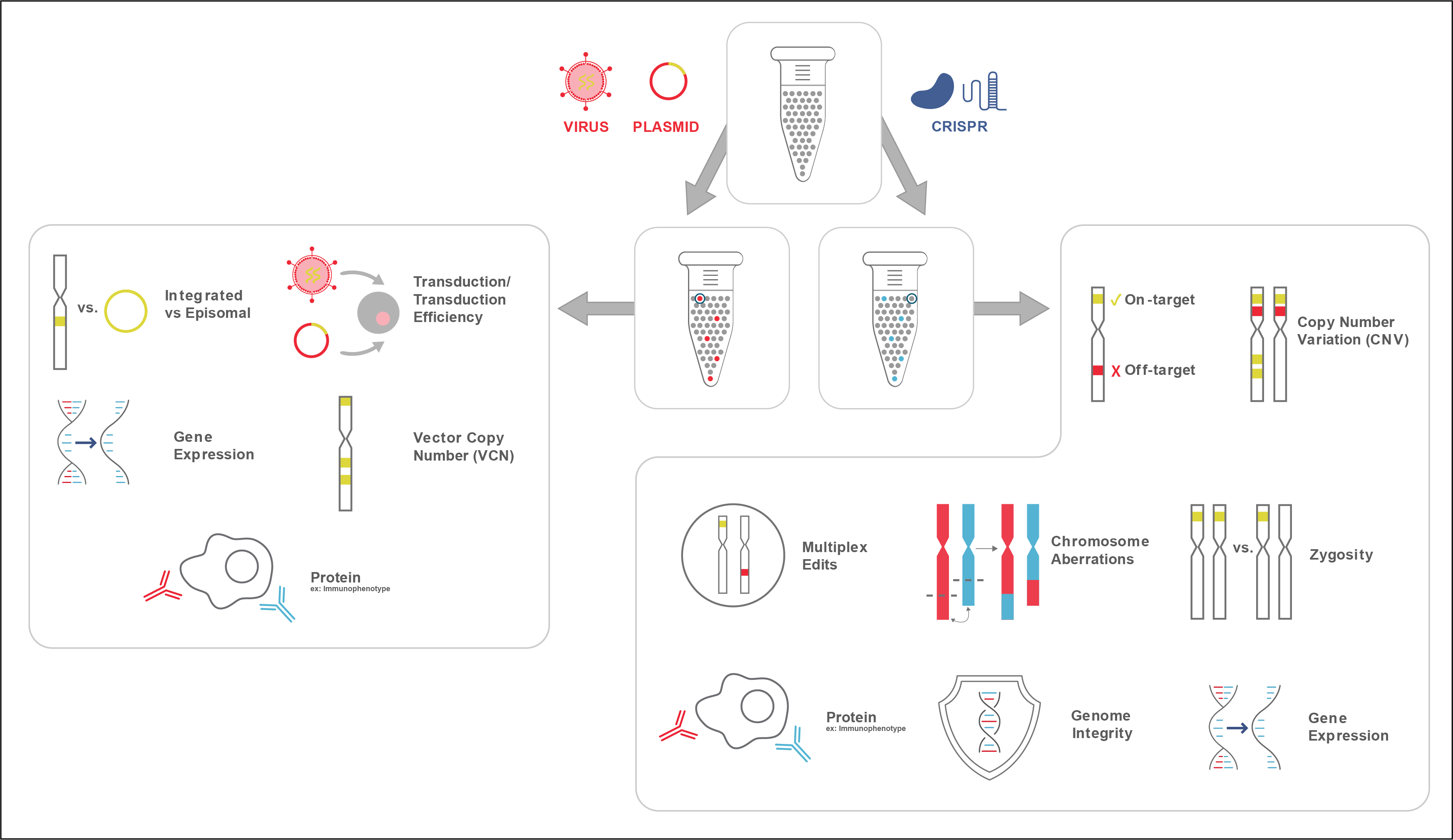
Attributes assessed across viral, plasmid, and CRISPR-based delivery methods on the Tapestri® single-cell multiomic platform.
Regulatory Alignment
Meet Regulatory Guidelines With Single-Cell Multiomics
The U.S. Food and Drug Administration (FDA)'s April 2026 draft guidance, Safety Assessment of Genome Editing in Human Gene Therapy Products Using Next-Generation Sequencing (NGS), recommends NGS-based methods to characterize on-target editing outcomes, assess off-target editing risk, and evaluate loss of genome integrity, including chromosomal translocations, in nonclinical studies supporting Investigational New Drug (IND) applications and Biologics License Applications (BLAs). This guidance builds on the FDA's January 2024 guidance for Human Gene Therapy Products Incorporating Human Genome Editing by providing more specific recommendations for genomic safety assessments.
Mission Bio Assay Services is designed to support these FDA-recommended NGS assessments through a single-cell multiomic approach that simultaneously measures DNA genotype, targeted gene expression, and cell-surface protein expression within individual cells. Rather than averaging results across millions of cells, the platform resolves on-target edits, off-target events, chromosomal translocations, clonal heterogeneity, and cellular identity in a single assay. The same analytical framework can also be applied to in vivo genome editing programs to characterize tissue- and cell-type-specific editing, biodistribution, and editing efficiency.
The FDA's Platform Technology Designation Program recognizes that sponsors developing multiple gene therapy products from a common therapeutic platform such as a genome editing nuclease, viral vector, or lipid nanoparticle delivery system may be able to use prior scientific knowledge across related programs. While each investigational gene therapy product still requires product-specific evidence, the FDA encourages the reuse of validated manufacturing, nonclinical, and analytical approaches when scientifically justified.
This regulatory guideline also creates an opportunity for reusable platforms. A validated single-cell multiomic assay can be applied across multiple gene therapy programs built on the same gene editing platform, generating consistent measurements of editing efficiency, genome integrity, clonal composition, vector integration, map downstream pathway expression, and cellular phenotype. Rather than developing a new analytical workflow for every indication, sponsors can build a standardized characterization strategy that supports comparability studies, manufacturing changes, and regulatory submissions across an entire portfolio of genome editing therapeutics. As organizations expand from one lead candidate to multiple products built on the same editing technology, a reusable single-cell analytical platform can improve consistency, reduce assay redevelopment, and support regulatory interactions through a common evidence framework.
Applications
Where Single-Cell Multiomics Fits Across Gene Therapy, Cell Therapy, and Gene Editing Applications.
From basic research and translational science to preclinical development and clinical studies, single-cell multiomic assays provide integrated DNA, RNA, and protein measurements at single-cell resolution, revealing biological mechanisms, cellular heterogeneity, therapeutic responses, genotoxicity, and safety assessments that legacy workflows cannot resolve.
Ex Vivo Cell Therapy
Characterizing the Product Before It Reaches the Patient
Ex vivo cell therapies are manufactured outside the body, meaning every quality attribute of the living cellular product should be measured prior to infusion. Standard release assays report vector integration and phenotype as two separate, population-level readouts, forcing developers to infer how the two connect. Single-cell multiomics measures vector copy number, transduction efficiency, and immunophenotype within the exact same cell, directly linking integration events to the surface phenotype of the specific cells that make up your product.
In Vivo Cell Therapy
Confirming the Right Cell Type Was Reprogrammed
In vivo cell therapy approaches, such as a lipid nanoparticle (LNP)-mRNA strategy that reprograms T cells directly inside the patient rather than manufacturing them ex vivo, remove the manufacturing step but add a new safety question: which endogenous cell types took up the reprogramming construct and expressed the intended receptor. Standard biodistribution assays report tissue-level uptake without confirming that the correct cell type expressed the construct at a functional level. Single-cell multiomics links vector uptake, receptor expression, and immunophenotype within the same circulating or tissue-resident cell, confirming which cell type was successfully reprogrammed in vivo.
Gene Therapy
Resolving Genome Integrity and Functional Outcomes
Gene therapy programs that use viral vectors, such as adeno-associated virus (AAV), or CRISPR-based editing to correct or add genetic material need to confirm that the intended genetic change occurred without introducing unintended genomic changes elsewhere. Legacy analytical workflows run separate assays for vector integration, editing outcomes, and genome integrity, each reported as a population average across split samples. Single-cell multiomics simultaneously identifies the specific cell type that took up the genetic material while measuring the genetic modification, its genome integrity consequences, and downstream expression within the exact same cell. This provides the definitive dataset needed to thoroughly characterize a gene therapy product's safety profile and functional efficacy.
Disease Modeling
Validating Models and Linking Edits to Biology
Translational researchers frequently rely on edited cell lines, patient-derived models, or animal models to characterize complex disease mechanisms. Legacy bulk sequencing can confirm that a genetic change occurred, but it cannot validate whether the model accurately recapitulates the heterogeneous disease state at the cellular level. Single-cell multiomics links genotype directly to transcriptional and phenotypic outcomes within the exact same cell. This provides the rigorous, publication-grade data needed to definitively validate the disease model, interpret how a specific edit drives the underlying biology, and confidently apply it in downstream experiments.
Biodistribution Studies
Resolving Which Cell Types Were Actually Edited
Biodistribution studies for in vivo gene therapies and gene editing programs must resolve not just which tissues a therapeutic payload reached, but which specific cell types within each tissue were actually edited or transduced. Standard nonclinical biodistribution workflows use qPCR or ddPCR to quantify vector genome copies across tissue homogenates and bulk NGS to report editing frequency, both of which average across every cell type in the sample and can mask on-target editing confined to a small target-cell subpopulation or bystander editing in an unintended tissue. Single-cell multiomics maps editing outcomes, zygosity, and transcriptional stress response by cell type across multiple organs in the same assay, distinguishing intended target-cell editing from bystander uptake.
Safety and Genotoxicity
Confirming On-Target Efficacy and Detecting Off-Target Effects
For researchers utilizing CRISPR and other gene editing technologies, not evaluating off-target effects can critically impact the results of the downstream experiments conducted. Bulk sequencing can confirm that edits happened, but it cannot reveal whether an on-target success and an off-target mutation exist in the same cell. While genome-wide nomination methods identify candidate off-target sites, only single-cell multiomics can measure on-target and off-target editing status simultaneously within individual cells, providing a direct quantification of edit co-occurrence, revealing hidden genotoxic events, and letting researchers move their experiments forward without confounding variables.
CAR-T Optimization
Tuning Manufacturing to Control Vector Copy Number
Optimizing a CAR-T manufacturing process means tuning viral titer, transduction protocol, and cell selection to hit a target vector copy number and CAR-positive fraction without drifting batch to batch. Bulk vector copy number methods report one average across the entire product, diluted by untransduced cells, and cannot show whether integration differs across T cell subsets such as CD4-positive and CD8-positive populations. Single-cell profiling of vector copy number, transduction efficiency, and surface CAR expression in the same cell reveals lineage-specific integration patterns and identifies rare, high-copy cells before they reach a patient, giving process development teams the resolution needed to tune and control manufacturing consistency.
Support
End-to-End Scientific Support Across Your Project
From the first conversation to final data delivery, the Assay Services team takes on every step. Each project is staffed with dedicated scientists who handle assay design, wet lab execution, data analysis, and long-term method support so your team can focus on the biology, not the infrastructure.
Scope Project
Panel & Assay Design
Wet Lab
Data Analysis
Long-term Pipeline Support
Assay Transfer & Scale-up
Step 01
Scope Project
The Mission Bio Assay Services team meets with your team to understand your targets of interest, sample type, program goals, and any regulatory or transfer requirements. This scoping call defines the assay strategy, sets a realistic timeline, and aligns expectations before any wet lab work begins.
Step 02
Panel and Assay Design
We work alongside your team to design your panels for the Tapestri® platform. Whether you bring your own targets or need assistance selecting the right DNA, RNA, protein, or epigenetic markers, we partner with you to finalize the panels for your project. Panel design incorporates sample constraints, coverage requirements, and multi-attribute needs, with your review and sign-off before moving to the bench.
Step 03
Wet Lab Execution
Mission Bio scientists run the assay in their dedicated laboratory using optimized, validated protocols on the Tapestri® platform. Quality checkpoints are built into the workflow at each stage, from single-cell encapsulation through library preparation and sequencing, to ensure data quality before analysis begins.
Step 04
Data Analysis and Reporting
We process the sequencing data to clearly resolve variants, RNA expression, and protein signal at the single-cell level. Analyzed results are delivered with annotated reports and visualizations that connect directly to your biological question, ready for internal review or regulatory submission.
Step 05
Long-Term Project Support
As your program evolves, our team provides ongoing scientific consultation, offering support for follow-up experiments, result interpretation, and the preparation of methods documentation for publications or assay transfer.
Step 06
Assay Transfer and Scale-Up
When your program is ready to move to a partner site, contract research organization (CRO), or contract development and manufacturing organization (CDMO), the team prepares transfer-ready documentation including installation, operational, and performance qualification (IOQ/PQ) protocols, standard operating procedures (SOPs), and validated analysis workflows. Assays are designed from the start with transfer in mind, reducing failure risk when moving between environments or scaling across development phases.
Resources
Technical Content and Program Guides
Explore technical notes, blogs, and brochures relevant to single-cell multiomic Assay Services for cell & gene therapy development and gene editing applications.

Talk to a Scientist to Scope Your Assay Project
Whether you are characterizing the safety profile of your cell & gene therapy or performing CRISPR gene editing experiments in the lab, the Mission Bio Assay Service team scopes the right assay for your program. No instrument purchase. No new bioinformatics team. Results delivered and transferable.
FAQs
Frequently Asked Questions About Single-Cell Assay Services for Cell and Gene Therapy and Gene Editing Applications
Assay Services is a fully managed partnership designed specifically for cell and gene therapy developers and gene editing researchers. It provides complete execution of single-cell DNA, RNA, protein, and epigenetics assays on the Tapestri® platform. Rather than purchasing instruments and scaling internal bioinformatics teams, developers and investigators work directly with Mission Bio scientists who run every step from custom panel design to advanced data analysis. By linking genetic modifications, transcriptional states, and surface protein expression within the exact same cell, the service generates a single, integrated biological profile. This allows cell & gene therapy developers to rigorously characterize product safety and lets researchers definitively map editing outcomes, delivering insights that separate single-modality assays simply cannot replicate.
Evolving FDA guidance explicitly requires rigorous safety assessments for genome editing and viral vector products, including deep characterization of genome integrity, off-target editing risks, and strict vector copy number (VCN) limits. Legacy bulk sequencing methods struggle to meet these standards because they average data across mixed cell populations, which easily masks rare genotoxic events and high-copy outliers. Assay Services meets these regulatory expectations through purpose-built single-cell multiomics assays. By running these specialized assays on the Tapestri® platform, the service delivers the single-cell resolution regulators will want. It identifies chromosomal translocations, characterizes off-target co-occurrence, and quantifies VCN strictly within the transgene-positive cell population, providing the safety dataset required to confidently advance clinical pipelines.
The FDA recommends that the average vector copy number be calculated relative to the percentage of CAR-positive cells rather than the total cell population. Total-cell denominators are diluted by untransduced cells, which artificially lowers the average and underestimates the true integration rate. Additionally, the FDA recommends that VCN remain below five copies per genome to mitigate the risk of insertional mutagenesis at higher copy numbers. Single-cell VCN profiling natively measures this exact distribution directly across thousands of individual cells, eliminating the need to infer safety metrics from a flawed population average.
Yes. Single-cell multiomic assays measure on-target and off-target editing status within the same individual cell, directly answering whether the cells carrying a therapeutic edit are also the cells carrying an unintended off-target event. Genome-wide off-target nomination methods identify candidate off-target sites across a population but cannot determine co-occurrence at the single-cell level.
The FDA Platform Technology Designation Program allows developers to reduce redundant nonclinical work by using prior data from a shared platform technology, such as a specific AAV vector or gene editing mechanism. However, proving cross-product comparability requires rigorous and standardized analytics. Assay Services supports this strategy by delivering fully managed, reproducible single-cell multiomics workflows. Once our team builds an assay to characterize the genome integrity, off-target profile, or vector copy number of your foundational platform, that same assay and its validated bioinformatics can be adapted for all subsequent product candidates to maximize pipeline efficiency.
Evaluating in vivo gene editing therapies requires tracking not just where the delivery vehicle traveled, but which cells were functionally modified. Legacy workflows rely on bulk tissue homogenates, using qPCR or ddPCR for vector copy number and bulk NGS for editing frequency. These bulk measurements average data across mixed cell populations, masking whether an edit occurred in the correct therapeutic cell type or an unintended bystander cell. Single-cell multiomics addresses this by analyzing individual cells across multiple organs in a single assay. It directly links gene therapy delivery to specific cell types while measuring precise editing outcomes, zygosity, and cellular stress, providing the resolution required to confirm in vivo target specificity and safety.